Postpartum · 9 min read
Diastasis Recti: what it is, how to check yourself, and what actually fixes it
Most postpartum core programs skip the screen. They shouldn't. Here's exactly what diastasis recti is, how to check yourself at home in 60 seconds, and what actually closes the gap.
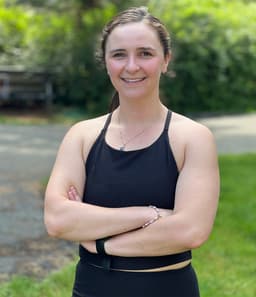
By Lexi Krieger · NASM-CPT, Pre/Postnatal Performance Specialist · April 12, 2026

About 60% of women still have a measurable diastasis recti at six weeks postpartum. A meaningful fraction never fully close it without intervention — not because their body is broken, but because nobody ever screened them, taught them what to do, or told them what to avoid.
If you feel your abdominal separation is affecting your movement, we can check at your first session. It takes 60 seconds. Here's exactly what I'm looking for, what it means, and how you can check yourself at home.
What diastasis recti actually is
Your rectus abdominis — the "six-pack" muscles — runs in two columns down the front of your abdomen, joined by a strip of connective tissue called the linea alba. During pregnancy, that connective tissue stretches to make room for the baby. Sometimes it stretches more than the body can recoil from after birth, leaving a gap between the two columns.
That gap is diastasis recti. The technical threshold is typically a separation of more than 2 finger-widths (about 2 cm), measured at three points: at your belly button, 2 inches above, and 2 inches below.
But the depth of the gap matters as much as the width. A shallow gap with good connective tissue tension responds well to training. A deep gap that you can sink your fingers into — even if it's only 2 finger-widths wide — needs more careful work.
How to self-check in 60 seconds
- Lie on your back, knees bent, feet flat on the floor.
- Place two fingers horizontally just above your belly button, palm facing your chin.
- Lift your head and shoulders slightly off the floor — like the very start of a crunch.
- Feel for the two muscle columns rising on either side of your fingers. Press gently down between them.
- Note: how many fingers fit between the columns, and how deep your fingers sink. Repeat 2 inches above and 2 inches below your belly button.
What you should avoid (especially early on)
- Crunches, sit-ups, and any movement that bulges your abs forward — you're literally training the muscles to hold the separation.
- Heavy front-loaded movements (front squats, hanging from a bar, planks if you can't hold without coning) until your deep core can support the load.
- Twisting at the spine under load — chops, Russian twists, oblique work — until the linea alba has more tension.
- Holding your breath through lifts (the Valsalva maneuver) until you've retrained pressure management.
What actually closes the gap
Diastasis rehab is mostly about pressure management: teaching your deep core (transverse abdominis), diaphragm, and pelvic floor to coordinate so that pressure exits the system properly when you brace, lift, or breathe.
The non-negotiable starter pack
- Diaphragmatic breathing — 5 minutes a day. Hand on chest, hand on belly. Inhale through the nose, expand the belly (and side ribs, and lower back). Exhale through pursed lips, feel the deep core engage.
- Transverse abdominis activation — Lying on your back, knees bent, exhale and draw the lower belly toward the spine without flattening the lower back. Hold 5 seconds, repeat 10 times. Build to standing.
- Pelvic floor coordination — Not just kegels. Learn to release the floor on inhale, gently engage on exhale. Many postpartum moms over-grip and need to teach the floor how to relax.
- Glute and posterior chain work — Bridges, clamshells, hip thrusts. Strong glutes take pressure off the linea alba.
Progressing to strength
Once you can perform the starter pack without coning, doming, or holding your breath, you graduate to loaded carries (suitcase carry, farmer's carry), unilateral lower-body work (split squats, step-ups), pulls (rows), and pushes (incline press). Reintroduce bilateral lifts (squats, deadlifts) carefully, watching the abdominal wall for any doming on the lift.
When to see a pelvic floor PT instead of (or alongside) a trainer
- You have ongoing pelvic pain, pressure, or a sense of heaviness in the perineum.
- You're leaking urine when you sneeze, jump, or run — and it isn't improving with breathing/coordination work.
- Your gap is larger than 3 finger-widths or deeper than your second knuckle.
- You can feel a bulge or hernia at the midline when you cough or strain.
- You had a C-section with complications, infection, or unusual scar adhesions.
I work with several pelvic floor PTs across the Lehigh Valley and will refer you out the moment your case warrants it. There's no ego in postpartum care — the right professional at the right time speeds your recovery.
If you want me to screen you
Diastasis screening is included in every new 1-on-1 client's first session, and I'll do a quick check at any group class on request. See postpartum training, or DM me with questions specific to where you are.